


Deniable vs Glacier: a managed secure phone, or one that survives a forced unlock?
Glacier hardens the phone and the network around it for enterprise teams. Deniable answers one moment neither hardening nor encryption covers: someone standing in front of you, making you unlock. Here is which problem each one solves.
If you are comparing secure phones, you have probably found Glacier. It is a serious product from a serious company, and for a lot of buyers it is the right answer.
It is also answering a different question than we are. Glacier hardens the device and the network around it, and wraps that in a managed service. Deniable is about one specific moment: someone is standing in front of you and making you unlock the phone. Both matter. They are not the same problem, and the honest comparison is about which one you actually face.
Everything below about Glacier comes from their own published materials. Where their documentation does not cover something, we say so rather than guess.
What Glacier is
Glacier Security has been building secure communications since 2015, out of Annapolis Junction, Maryland. Their offer is a package, not just an operating system:
- Hardened devices. Guardian covers commercial hardware, including iPhones, Android phones and laptops, configured to their security architecture. They also ship altOS, a custom Android built from AOSP and flashed in their own facility, running on Google Pixel devices.
- The network, not just the phone. Private SIMs, isolated per-device networks, anonymised routing, what they call Moving Target Defense, and threat monitoring on top.
- Encrypted comms across the board. Messaging, voice, video and file transfer, end-to-end.
- Separate environments on one device: they describe work, personal and mission profiles side by side.
- A service wrapped around it. Devices configured by former US government security staff, hand-delivered by their agents, managed through a console, sold by demo and quote rather than a checkout.
Their buyers are executives and protection teams, high-net-worth families, governments and high-risk individuals. If that is you, and your worry is interception, fleet management and support, Glacier is built for exactly that and we would not pretend otherwise.
What Deniable is
Deniable is an operating system you buy directly, built on the GrapheneOS hardening base, aimed at one failure mode: compelled access.
One phone, one lock screen, three PINs. The public PIN opens an ordinary, lived-in phone. The hidden PIN opens a separate environment encrypted so that on storage it is indistinguishable from unused space. The duress PIN opens the public side exactly as a normal unlock would, and erases the hidden environment in the background while it does. Restart and power off look completely normal, with no bootloader warning to give the game away.
The point is not to have more security than a hardened phone. It is that when you hand the phone over unlocked, there is nothing for an inspector to point at.
Where the two genuinely differ
Isolation is not deniability. This is the crux, and it is easy to miss. Glacier's separate work, personal and mission environments are real isolation: data in one does not leak into another. But an inspector holding the phone can see that other profiles exist, and can ask you to open them. Refusing is a choice with consequences. At a US border in 2025 there were more than 55,000 device searches, and in the UK refusing to hand over a password is itself an offence. Deniable's hidden environment is built so there is nothing visible to ask about.
A managed service versus a product you own. Glacier configures, delivers and monitors. That is a real advantage if you are equipping a team and want someone accountable at 3am. It also means procurement, a demo call and a quote. Their pricing is not published. Deniable is a licence you buy directly with public checkout, and phones are available with it pre-installed if you would rather not flash anything. Supported hardware spans Pixel 6 through Pixel 10 phone families on Tensor G1 through G5.
The network layer is theirs, not ours. Private SIMs, anonymised routing and threat monitoring are Glacier's territory and we do not compete there. If your adversary is watching the network, that is a genuine reason to choose them.
Neither of us is fully open. Glacier's altOS is derived from AOSP; whether altOS itself is published, their materials do not say. Deniable is closed-source today, with open-core and an independent audit on the roadmap. If auditability is your hard requirement right now, stock GrapheneOS is the honest answer for both of us. We wrote about why we build on top of it rather than against it.
On duress, their documentation is silent. We looked at Glacier's Guardian, altOS and app pages and found no mention of duress codes or plausible deniability. That is not a claim that the feature is absent. It is only a statement about what they publish or position on. Ours is the whole product.
How to choose, honestly
Ask what happens at the worst moment you can actually picture.
If it is a hostile network, a compromised laptop, a phone lost in a foreign city, or twenty devices across a team that someone has to keep patched, that is a managed-fleet problem, and Glacier is built for it.
If it is a person: an officer at a border with your phone in their hand, a robber who knows you hold crypto, a search where cooperating is the only safe option, hardening does not reach that moment. Encryption does not either, because you are the one being asked to decrypt it. That is the moment Deniable is built for.
And if both are true, they stack rather than compete: nothing stops a Deniable phone from living on a private SIM.
Glacier secures the phone and the network around it, as a managed service, priced by quote. Deniable makes an unlocked phone reveal nothing, as a licence you buy today. Pick by whether your threat is the network or the person in front of you.
Frequently asked
Does Glacier have a duress PIN or hidden vault?
Their published materials, including the Guardian page, the altOS page and the app page, do not mention duress codes, hidden vaults or plausible deniability. They document isolated work, personal and mission environments, which is separation rather than concealment. For a definitive answer, ask Glacier directly.
Can I run Deniable on the phone I already have?
If it is a supported Pixel 6 through Pixel 10 phone, yes. That includes the Pixel 8 and Pixel 10 families added with the Android 17 builds. See the live matrix on the install page for exact models. We also sell phones with DeniableOS pre-installed.
Is Deniable cheaper than Glacier?
We cannot compare directly, because Glacier does not publish prices. Their model is a demo and a quote. Ours is listed publicly on the pricing page before checkout.
Do I still need GrapheneOS if I use Deniable?
You are already running it. Deniable is built on the GrapheneOS hardening base, so you inherit its protection against malware, tracking and remote attackers, plus the deniability layer on top.
Which one do executives who travel choose?
It depends on the border, not the job title. If the risk is interception and device management across a team, a managed service fits. If the risk is being asked to unlock at a checkpoint, deniability is the feature that matters, and a hardened phone with visible extra profiles does not provide it.
More to read

They came for the person, not the wallet
The smart attacker skips the cryptography and goes straight for you; here is why a hardware wallet does not cover a $5 wrench attack, and what does.
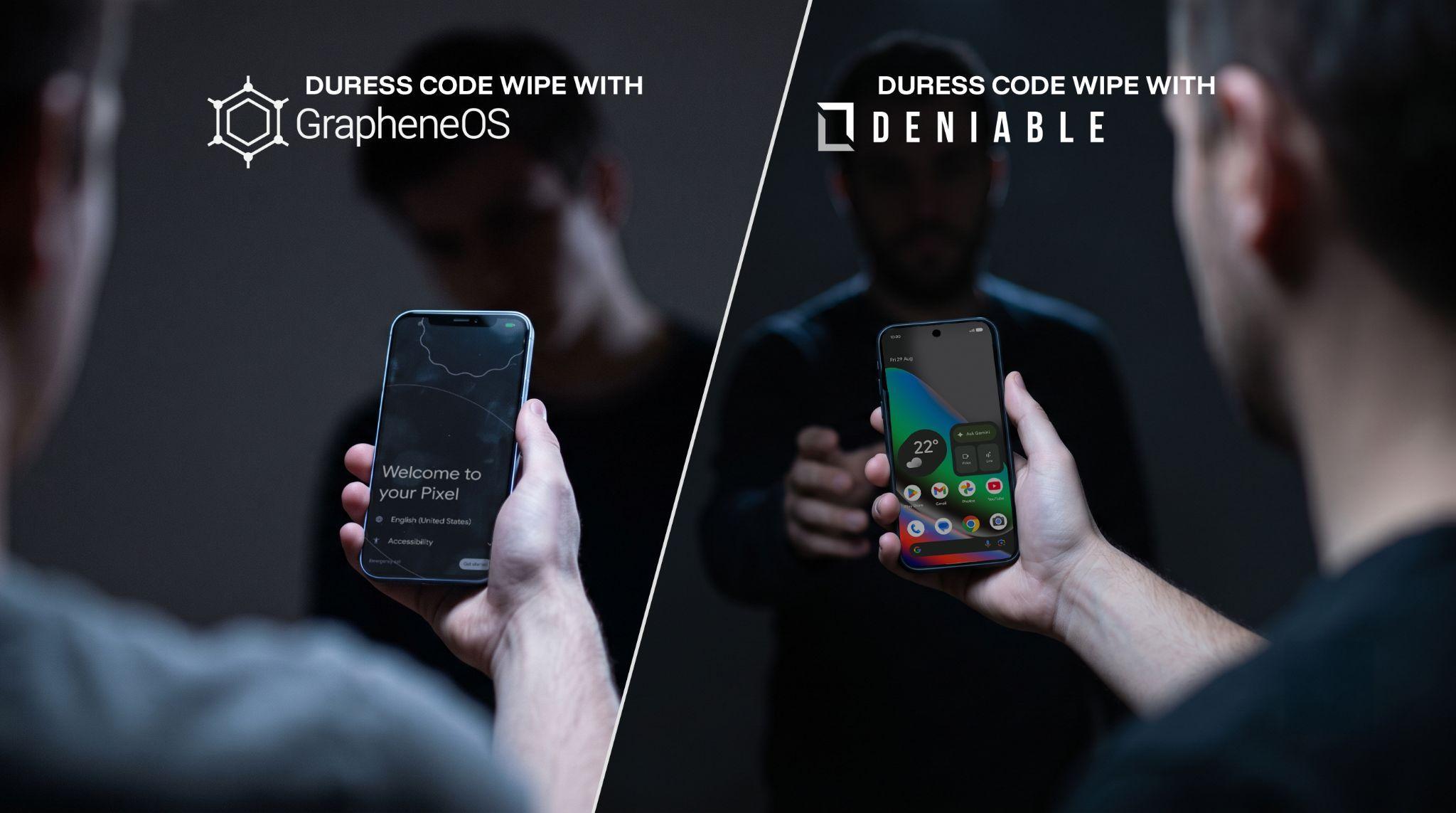
GrapheneOS vs DeniableOS: which one survives a forced unlock?
GrapheneOS is the best hardening base and DeniableOS is built on it; at the forced-unlock moment a duress wipe proves you hid something while a deniable unlock proves nothing.
Can they actually force you to unlock your phone?
Your passcode is closer to a formality than a wall; here is what the law actually allows at borders and under duress, and the one option most people miss.